
Fall 2026
Dear Friends and Fellow Good Trouble Makers,
In The R Word Fall 2026 blog post, we will share (1) our vision and mission, (2) a review of what we have done, (3) a preview of what we will do, (4) a fund update, and (5) a reflection.
Vision and Mission
The Zacchaeus Foundation is a non-profit named for Zacchaeus, who repented, repaired, and was healed.
We are working for racial healing in Northwest Arkansas (our vision).
We are repairing truth, wealth, and power (our mission).
We repair truth by educating white people and churches about reparations. We started events.
We repair wealth by raising funds from white people and churches for Black-led non-profits. We started The Zacchaeus Fund for Black-led non-profits.
We repair power by empowering Black people to decide who receives funds. Black board members decide who receives funds.
Review
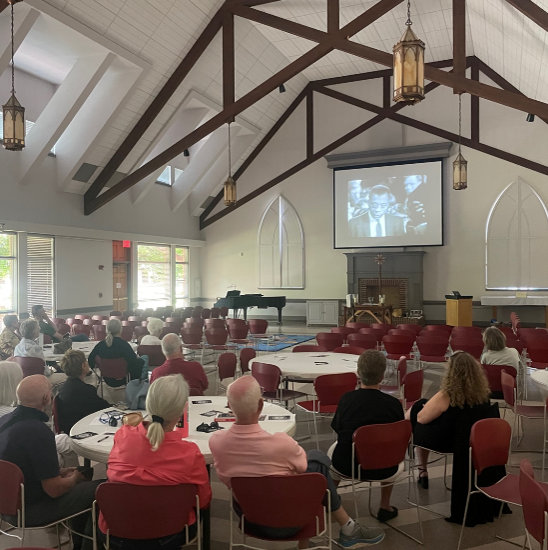
On Saturday July 11th, we viewed The Big Payback, a film about reparations featuring Robin Rue Simmons, and discussed how The Zacchaeus Foundation and The Zacchaeus Fellowship are working for racial healing in NWA and the USA. Learn more about The Zacchaeus Fellowship here.
Preview
On Saturday November 7th, from 5 to 7pm at St. Paul’s Church, we will enjoy food from Handshake and an annual report about The Zacchaeus Foundation. RSVP here.
The Zacchaeus Fund Update
The Zacchaeus Fund for Black-led non-profits is a donor advised fund held by Arkansas Community Foundation. The advisors of The Zacchaeus Fund are the Black board members of The Zacchaeus Foundation.
Our 2026 goal is to raise $110,000, which will enable us to invest $50,000 in Black-led non-profits in 2027.
Our 2035 goal is to raise an endowment of $1.4M, which will enable us to invest $50,000 in Black-led non-profits annually, perpetually.
Year to date, we have raised $80,000 (70% of our 2026 goal).
To help us raise $110,000 in 2026, invest in The Zacchaeus Fund here.
To join our fundraising team (people who invest and invite others to invest), email us at zacchaeusfoundation@gmail.com
Reflection
Dr. Caree Banton is a board member of The Zacchaeus Foundation. Read Caree’s reflection below.
As an academic, I have spent much of my career studying histories of inequality, displacement, resilience, and community formation. One of the lessons that emerges consistently from this work is that healing requires grounding in historical truth-telling. Communities cannot move forward without honestly confronting the past and understanding how historical injustices continue to shape present realities. This commitment to truth-telling is one of the reasons I am grateful to serve on the board of The Zacchaeus Foundation. The Foundation recognizes that racial healing is not simply about improving relationships across societal differences. It is also about addressing the material and structural consequences of historical injustice in meaningful and sustained ways.
The Foundation’s vision is inspired by the biblical story of Zacchaeus, whose transformation was marked not only by repentance but also by repair. That distinction is important. In both scholarship and public life, we often speak about reconciliation without fully grappling with accountability. Yet genuine healing requires more than acknowledgment; it requires action. The Foundation’s commitment to repairing truth, wealth, and power offers a practical framework for moving beyond conversation toward tangible change.
This year’s activities remind us that the academy remains a critical part of that process. Events such as the screening and discussion of The Big Payback create opportunities for learning, reflection, and dialogue. They invite participants from various communities to consider how reparative justice can be understood not as charity, but as a response to historical and ongoing inequities. Such conversations challenge assumptions, deepen understanding, and help build the collective will necessary for long-term transformation.
Equally important is the work of repairing wealth and power. Too often, communities most affected by systemic inequities are excluded from decisions about resources intended to support them. The Zacchaeus Fund models a different approach by placing decision-making authority in the hands of Black board members and investing in Black-led organizations. This structure reflects a core principle of justice: people closest to community challenges are often best positioned to identify community solutions.
As a board member, I am encouraged by the progress made this year and inspired by the Foundation’s ambitious goals for the future. Reaching our fundraising targets is important not only because of the dollars raised, but because those investments represent a growing commitment to a more equitable Northwest Arkansas. The vision of building a lasting endowment that can support Black-led nonprofits for generations reflects an understanding that racial healing is not a short-term project. It is an ongoing commitment that requires patience, courage, and persistence.
I remain hopeful because I have witnessed the power of education, community engagement, and collective action to create change. When people commit themselves to truth, repair, and shared responsibility, healing becomes possible. The work of The Zacchaeus Foundation reminds us that a more just future is built not only through reflection on the past, but through the choices we make today. I am honored to be part of this effort and look forward to the work that lies ahead.
Thanks for reading The R Word!
With hope for healing,
Lowell Taylor
Board Member, The Zacchaeus Foundation
zacchaeusfoundation@gmail.com