
Spring 2026
Dear Friends and Fellow Good Trouble Makers,
In The R Word Spring 2026 blog post, we will share (1) our vision and mission, (2) a review of what we have done, (3) a preview of what we will do, (4) a fund update, and (5) a reflection.
Vision and Mission
The Zacchaeus Foundation is a non-profit named for Zacchaeus, who repented, repaired, and was healed.
We are working for racial healing in Northwest Arkansas (our vision).
We are repairing truth, wealth, and power (our mission).
We repair truth by educating white people and churches about reparations. We started events.
We repair wealth by raising funds from white people and churches for Black-led non-profits. We started The Zacchaeus Fund for Black-led non-profits.
We repair power by empowering Black people to decide who receives funds. Black board members decide who receives funds.
Review
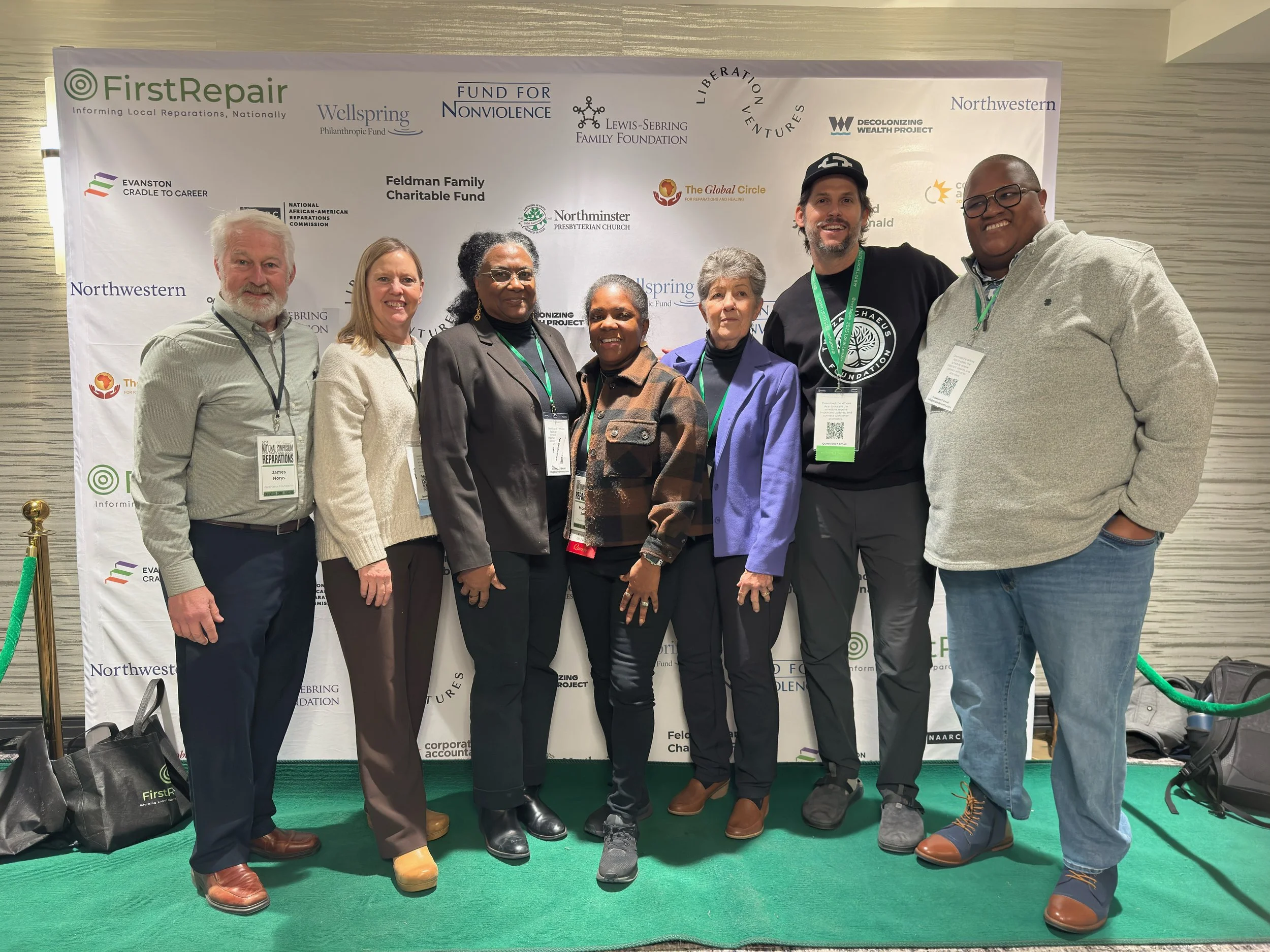
In December, seven people from Northwest Arkansas (Jim and Susie Norys, Sharon Killian, Monique Jones, Kathy Trotter, Lowell Taylor, and Dustin McGowan) attended the fifth annual FirstRepair National Symposium for State and Local Reparations, led by our friend Robin Rue Simmons, in Evanston, IL. The Zacchaeus Foundation was featured in the South Region Report, and Lowell was featured in the Local Leaders Cohort.
And in December, we met our goal to raise $100,000 for The Zacchaeus Fund in 2025. In January, the Black board members of The Zacchaeus Foundation selected two Black-led non-profits who will each receive $25,000 ($50,000 total) from The Zacchaeus Fund in 2026.
Preview
On Saturday March 7th, from 3 to 5pm at St. Paul’s Church, we will discuss Reparations: A Christian Call for Repentance and Repair by Kwon and Thompson and announce two Black-led non-profits who will each receive $25,000 from The Zacchaeus Fund in 2026. RSVP here.
The Zacchaeus Fund Update
The Zacchaeus Fund for Black-led non-profits is a donor advised fund held by Arkansas Community Foundation. The advisors of The Zacchaeus Fund are the Black board members of The Zacchaeus Foundation.
Our 2026 goal is to raise $110,000, which will enable us to invest $50,000 in Black-led non-profits in 2027.
Our 2035 goal is to raise an endowment of $1.4M, which will enable us to invest $50,000 in Black-led non-profits annually, perpetually.
To help us raise $110,000 in 2026, invest in The Zacchaeus Fund here. To join our fundraising team (people who invest and invite others to invest), email us at info@thezacchaeusfoundation.org
Reflection
Dustin McGowan is a board member of The Zacchaeus Foundation. Read Dustin’s reflection below.
Walking into the First Repair National Symposium on State and Local Reparations felt like stepping into a living archive of courage. Grassroots organizers, policy leaders, faith practitioners, and community builders from across the country gathered not simply to exchange ideas, but to bear witness to what repair already looks like in practice. There was a quiet beauty in the room, the kind that emerges when people who have been shaped by harm nevertheless choose to labor toward wholeness together.
The symposium’s theme, A.C.T. Acknowledge, Commit, Transform, was not offered as a framework to admire, but as a posture to inhabit. Acknowledgment, as it was practiced there, required disciplined truth telling. Communities spoke plainly about historical and ongoing harms, naming them without euphemism or defensiveness. This was not acknowledgment for the sake of catharsis, but for clarity. Repair cannot begin where truth is still contested or concealed.
Commitment moved the conversation from words to weight. Again and again, presenters emphasized that reparations fail when they remain aspirational. What marked the strongest efforts was their willingness to create durable structures. Budgets that reflect stated values. Policies that persist beyond election cycles. Decision making processes that locate authority with those most impacted. Commitment, in this space, meant binding ourselves to the work even when progress is incremental and resistance inevitable.
Transformation was where the symposium’s energy sharpened. The most compelling strategies were not always the most visible. They were often adaptive, relational, and at times intentionally subversive, finding ways to move resources, shift power, and reshape narratives even within resistant systems. This was a reminder that reparations work does not always advance in straight lines. Faithfulness sometimes looks like creativity, patience, and strategic collaboration across movements and sectors.
For me, the deepest takeaway was a renewed conviction that this work cannot be done in isolation. Repair is sustained through ongoing collaboration, shared learning, and a willingness to be shaped by one another’s experiences. This mirrors the work of The Zacchaeus Foundation in Northwest Arkansas. Our commitment to repairing truth, wealth, and power is not rooted in abstraction, but in local relationships and practical action. Like Zacchaeus, repair requires acknowledgment, commitment, and transformation that lead to tangible restoration.
Leaving First Repair, I felt both encouraged and sober. Encouraged by the victories already won and the wisdom being shared. Sober about the long road ahead. Yet convinced more than ever that when communities choose to act together, repair moves from possibility to practice.
Thanks for reading The R Word!
With hope for healing,
Lowell Taylor
Board Member, The Zacchaeus Foundation
info@thezacchaeusfoundation.org